Formula Student
Steering Wheel
An ongoing project to develop an integrated steering wheel with a 4.3 inch TFT display to deliver vehicle information from the CAN bus network to the driver.
01
Design Details
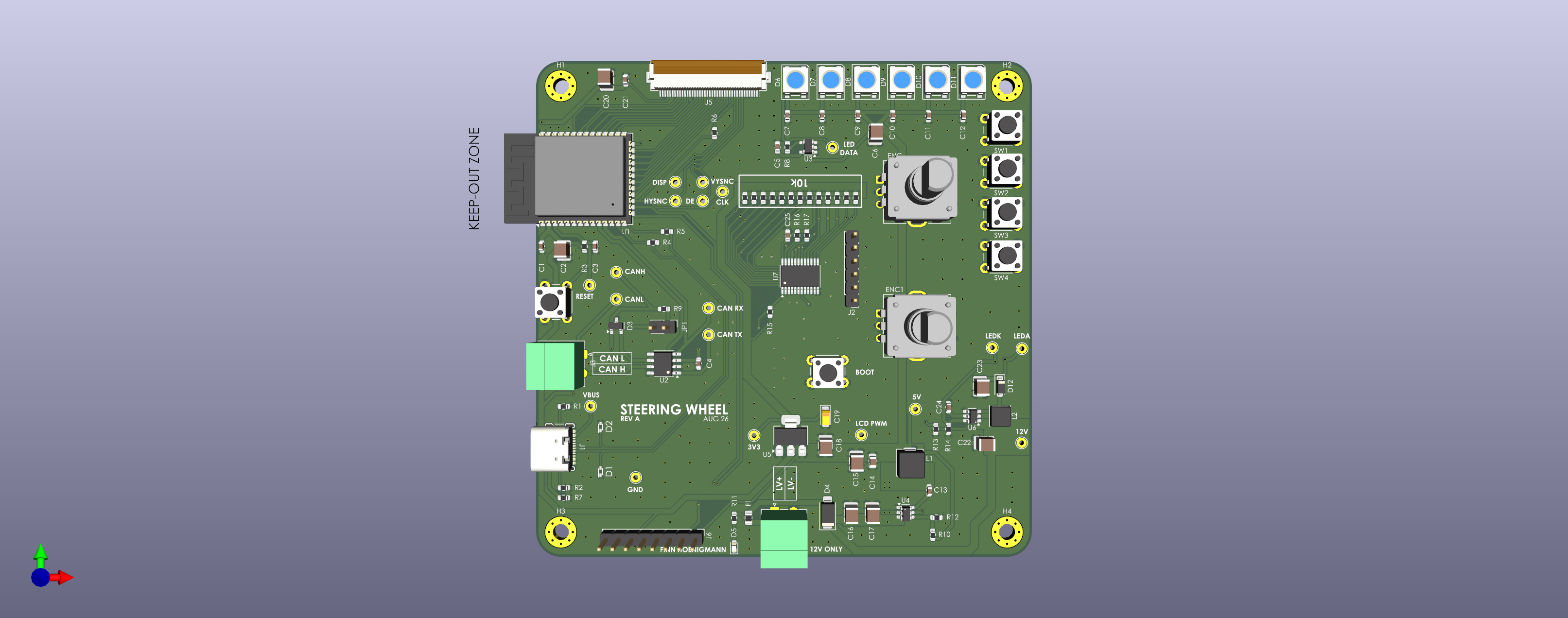
The initial PCB has been designed as an evaluation board, incorporating the core electronics intended for the final steering wheel while providing additional test points and a simplified square form factor for development and debugging.
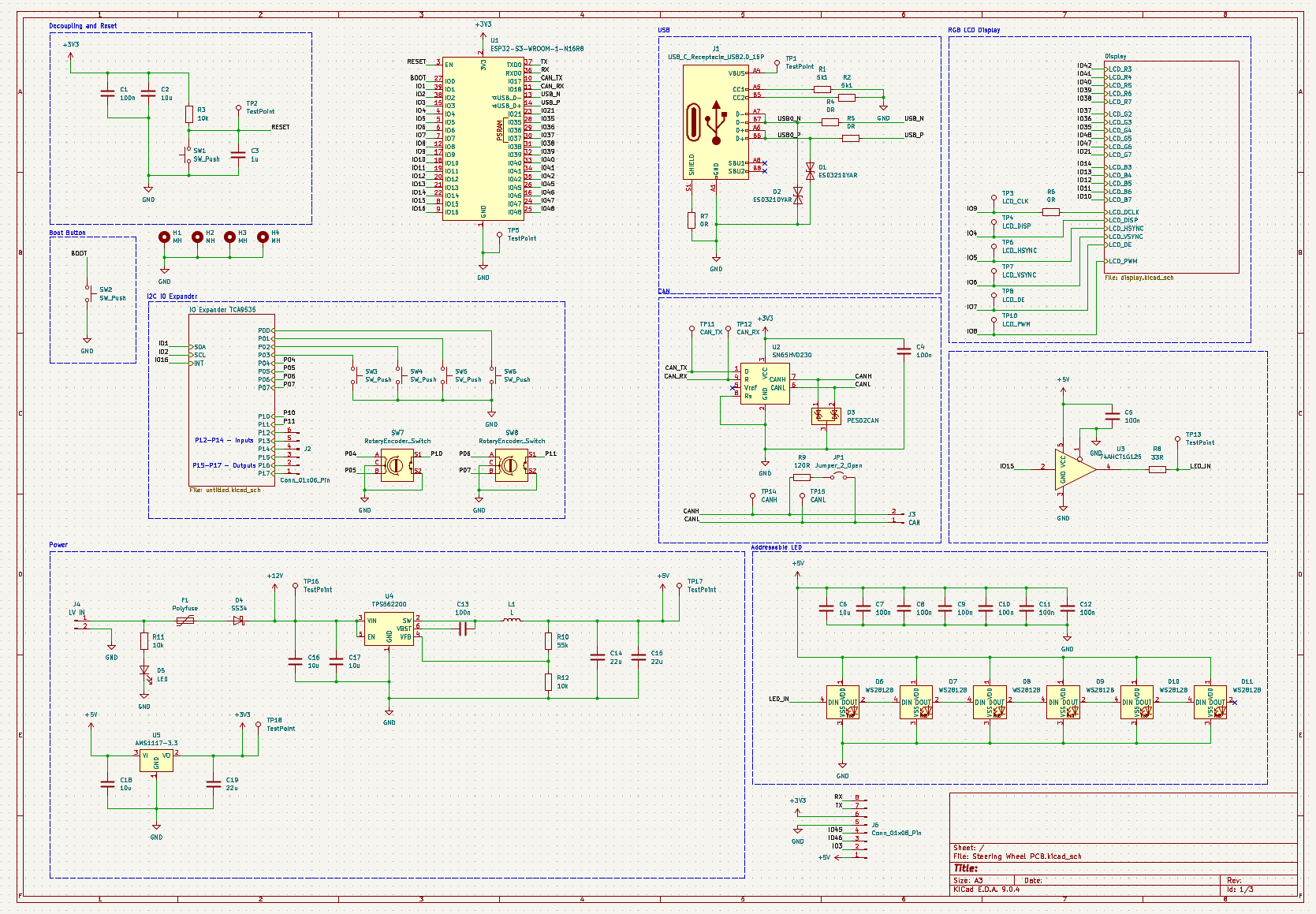
The board connects directly to an 800 x 480 RGB TFT display with a 1000-nit backlight. A constant-current LED driver powers the display backlight, while an ESP32-S3 with 16 MB of flash and 8 MB of PSRAM drives the RGB interface, providing sufficient external memory for full-frame buffering.
The ESP32-S3 can be programmed and debugged through USB-C, while an onboard CAN transceiver allows the steering wheel to receive real-time data from the vehicle CAN network. The 12 V input and power rails incorporate appropriate protection, with a buck converter generating 5 V and an LDO providing the 3.3 V supply.
An I2C I/O expander provides additional inputs for driver controls, including buttons and rotary encoders used to navigate display modes and acknowledge vehicle messages. The board also controls a series of addressable LEDs, which will provide the driver with a clear visual indication of battery state of charge and other vehicle status information.
02
Project Status
This project is currently a work in progress, with assembly and testing of the initial PCB due to begin shortly. In parallel, I will be developing the mechanical steering wheel assembly around an aluminium core with 3D-printed electronics housings. The design will consider mechanical strength, packaging and waterproofing, supported by FEA where appropriate. Custom grips will also be developed using laser-scanned clay forms shaped to the driver's hands.
The graphical interface will then be developed in C++, with dedicated screens for vehicle data including speed, battery status, temperatures and warnings. Data received over CAN will update the display in real time, while frame buffering will provide smooth graphical updates. Buttons and rotary encoders will allow the driver to navigate between screens and interact with the vehicle interface while keeping critical warnings and status information clearly visible.